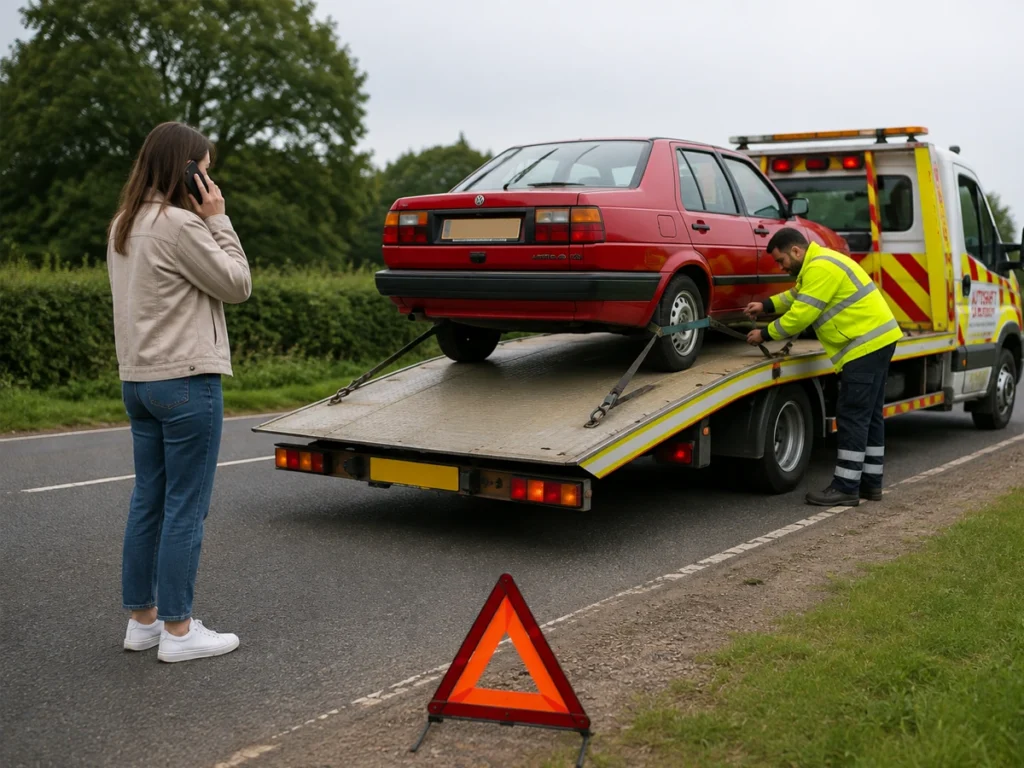
A car breakdown emergency can make even a familiar journey feel stressful. One minute you are driving as normal, the next you are dealing with warning lights, strange noises, loss of power, or a vehicle that simply will not move.
The safest response is not to panic or guess. It is to slow the situation down, protect yourself and your passengers, then decide whether the car can be moved safely or needs professional recovery.
At Autoshift Recovery, we help drivers across Stevenage, Hertfordshire, and surrounding areas when a breakdown, accident, wheel issue, battery fault, or motorway problem leaves them stuck. Here are the steps we recommend if your car breaks down and you need to make the right call quickly.
First, Get Yourself Out Of Immediate Danger
If the car is still moving, steer towards the safest available place. That might be a hard shoulder, lay-by, side road, car park, wide verge, or another spot away from traffic.
Do not try to “just make it home” if the car is losing power, overheating, smoking, leaking fluid, or showing serious warning signs. A short extra drive can turn a manageable recovery into a more expensive repair, especially if the engine, gearbox, brakes, or steering are affected.
If you are on a motorway or fast road, personal safety comes first. Use the official Highway Code breakdown safety rules and get behind the barrier if it is safe to leave the vehicle. Never stand between your car and moving traffic.
Put Your Hazard Lights On And Make The Car Visible
Switch on your hazard lights as soon as the vehicle becomes a hazard to other road users. If visibility is poor, use sidelights as well.
A warning triangle can be useful on ordinary roads, but do not use one on a motorway. Walking behind your vehicle on a fast road is not worth the risk. If you have a high-vis jacket, put it on before leaving the car.
This is the point where many drivers make the situation harder. They focus on the fault before they make the scene safe. The car can wait for a minute. Traffic will not.
Move Passengers To A Safer Place
Once the vehicle is stopped, think about where everyone is standing. Passengers should usually leave the vehicle from the side away from traffic if it is safe to do so.
Keep children, older passengers, and pets away from the road. On busy roads, motorway slip roads, or fast A-roads, staying beside the car can be more dangerous than the breakdown itself.
If you cannot leave the vehicle safely, keep seatbelts on and call for help. A breakdown in a tight lane, live carriageway, dark road, or blind bend needs a different approach from a flat battery on a driveway.
Check The Vehicle Only If It Is Safe
If the car is in a safe position, you can make a quick check from outside the vehicle. Look for obvious issues such as a flat tyre, steam, smoke, fluid underneath the car, or damage after an impact.
Do not put yourself under the bonnet beside moving traffic. Do not crawl around the car on a live road. And do not keep restarting the engine if there are signs of overheating, oil pressure problems, smoke, or harsh mechanical noises.
A breakdown emergency is not the time for guesswork. If the car feels unsafe to drive, arrange local car recovery rather than trying to push on.
Decide Whether It Is A Roadside Fix Or Recovery Job
Some issues can be solved where the car is parked. A flat battery may only need a jumpstart. A wheel issue may be manageable if the car is somewhere safe and the spare wheel is usable.
Other faults need recovery. These include serious warning lights, overheating, loss of power, brake or steering problems, clutch or gearbox trouble, accident damage, repeated battery failure, or any fault that makes the car unsafe to drive.
From our work in vehicle recovery, the decision usually comes down to three things: where the vehicle has stopped, whether it can be accessed safely, and whether continuing could cause more damage. A car stuck in a station car park is a different job from a vehicle on a faster road, a busy commuter route into Stevenage, or a town with heavy local traffic such as Hatfield.
Do Not Attempt Risky Roadside Repairs
Trying to fix a fault beside traffic can put you in more danger than the original breakdown. Even a simple wheel change becomes risky if the car is on a narrow road, dark lane, or fast route.
If you cannot work safely around the vehicle, do not start. Call for roadside breakdown recovery and explain exactly where you are.
This is especially important for motorway and faster-road breakdowns. Follow National Highways emergency advice: go left where possible, get safe, and get help. The priority is to reduce exposure to traffic, not to diagnose the problem at the roadside.
Share Clear Information When You Call For Help
When you contact a recovery service, give practical details first:
- Your exact location, including road name, junction, postcode, nearby landmark, or what3words if available
- The direction of travel if you are on a major road
- Vehicle make, model, and registration
- What happened before the breakdown
- Whether the vehicle can roll, steer, or brake
- Whether you are in a safe place
- Where you want the vehicle taken
Autoshift Recovery is based in Stevenage and provides 24/7 vehicle recovery and roadside support across Hertfordshire and surrounding areas. Whether you are dealing with a breakdown near Stevenage, on the A41 around Hemel Hempstead, or on a smaller local road, speaking directly with an experienced recovery driver makes it easier to explain the situation clearly.
Be Careful With “Near Me” Choices
When you search for “recovery near me” during a breakdown, you are usually stressed and short on time. That is when it is easy to choose the first number you see without checking whether the company can actually handle the situation.
Look for signs of a real recovery service: clear contact details, relevant services, local coverage, and public feedback. Autoshift Recovery was founded in 2005 by Paul Clarke and has grown from classic car transportation into wider recovery and roadside support. Public reviews commonly highlight quick response, clear communication, fair pricing, and professional help.
Do not rely on price alone. A recovery job needs safe loading, the right judgement, and a clear destination plan.
Know Where The Vehicle Should Go
Before recovery arrives, think about where the vehicle needs to be taken. It might be your home, a garage, a repair centre, a workplace, or another safe destination.
If the car is badly damaged, will not start, or has a fault that could get worse, a garage may be the sensible choice. If it is late at night, your first priority may be getting the car and passengers home safely, then arranging repairs afterwards.
A good recovery conversation should cover both the vehicle and the driver. If the vehicle cannot be driven or needs careful loading, recovery truck services may be the safest way to move it without adding further risk.
Learn From The Breakdown Once You Are Safe
After the recovery, make a note of what happened. Warning lights, noises, smells, changes in steering, loss of power, or overheating can all help the garage diagnose the fault.
If the issue was a battery, tyre, fluid leak, or recurring warning light, do not ignore it once the immediate stress has passed. Breakdowns often feel sudden, but many give small warnings first.
The useful lesson is simple: act early when the car feels wrong. Waiting until it fails completely can leave you stranded somewhere much less convenient.
Common Causes of Car Breakdowns
Most breakdowns start with a fault that has been building for a while. Knowing the common causes can help you spot warning signs early and decide when to stop driving.
- Flat or failing battery: Slow starting, dim lights, clicking when you turn the key, or repeated jumpstarts can point to battery or charging issues.
- Tyre and wheel problems: Punctures, damaged sidewalls, worn tread, or wheel damage can make the car unsafe to drive, especially at speed.
- Overheating: Rising temperature gauges, steam, coolant smells, or warning lights can suggest coolant leaks, fan faults, radiator issues, or engine problems.
- Alternator or electrical faults: Battery warning lights, flickering dashboard lights, or sudden power loss may mean the car is not charging properly.
- Fuel issues: Running out of fuel, using the wrong fuel, or dealing with fuel delivery problems can stop the vehicle from running safely.
- Clutch, gearbox, or transmission faults: Difficulty changing gear, slipping, grinding, or loss of drive can quickly turn into a recovery job.
- Brake or steering problems: Unusual pulling, heavy steering, soft brake pedals, grinding noises, or warning lights should be treated as safety-critical.
- Accident or impact damage: Even if the car still moves, hidden damage can make it unsafe to continue.
If any fault affects steering, braking, engine temperature, visibility, or vehicle control, stop somewhere safe and arrange help instead of taking a chance.
Do vs Don’t During A Breakdown
| Do | Don’t |
|---|---|
| Move the vehicle away from traffic if it is safe. | Keep driving with smoke, overheating, or serious warning lights. |
| Switch on hazard lights and make the car visible. | Stand in a live lane or between your car and traffic. |
| Move passengers to a safer place away from the road. | Let children, passengers, or pets wait near moving traffic. |
| Call for professional help if the car feels unsafe. | Attempt repairs on a motorway, fast road, blind bend, or narrow lane. |
| Give clear location, vehicle, and destination details. | Rely on vague directions or assume the driver can find you easily. |
| Follow official motorway and roadside safety guidance. | Use a warning triangle on a motorway. |
| Wait somewhere safe until help arrives. | Accept a risky roadside fix just to save time. |
Quick Breakdown Checklist
- [ ] Stay calm and slow down safely if the vehicle is still moving.
- [ ] Pull over to the safest available place, away from traffic where possible.
- [ ] Put hazard lights on immediately.
- [ ] Use sidelights in poor visibility.
- [ ] Move passengers away from the road if it is safe to leave the vehicle.
- [ ] Avoid standing behind, in front of, or beside the vehicle on fast roads.
- [ ] Check for obvious issues only if the vehicle is in a safe position.
- [ ] Do not restart the engine repeatedly if there is smoke, overheating, or mechanical noise.
- [ ] Note your exact location, direction of travel, and nearby landmarks.
- [ ] Call for recovery if the vehicle is unsafe, damaged, or cannot continue.
- [ ] Decide where the vehicle should be taken before recovery arrives.
- [ ] Keep your phone charged and stay reachable until help gets to you.
FAQ
What Should I Do First In A Car Breakdown Emergency?
Your first priority is personal safety. Move the vehicle away from traffic if you can, switch on hazard lights, and get passengers to a safer place before checking the car or calling for recovery.
Should I Stay In The Car During A Breakdown?
It depends where the car has stopped. On a motorway or fast road, it is usually safer to leave the vehicle and move behind the barrier if you can do so safely. If leaving the car would put you in more danger, keep seatbelts on and call for help.
When Should I Call For Car Recovery Instead Of Driving On?
Call for recovery if the car feels unsafe, has serious warning lights, overheats, loses power, has steering or brake issues, leaks fluid, smokes, or has accident damage. If you are unsure, it is safer to ask for advice than risk making the fault worse.
Can A Flat Battery Be Fixed Without Recovery?
Sometimes, yes. A jumpstart can help if the battery is the only issue and the vehicle is otherwise safe. If the car does not respond, cuts out again, or shows electrical faults, recovery or garage inspection may be needed.
What Information Does A Recovery Driver Need?
Give your exact location, direction of travel, vehicle details, what happened, whether you are safe, and where you want the vehicle taken. Clear information helps the recovery driver plan the safest approach before arrival.
If a breakdown happens, the right response is calm and practical: get safe, make the vehicle visible, avoid risky roadside fixes, and arrange help when the car should not be driven. A few careful decisions at the start can prevent injury, further damage, and a much more stressful recovery.
Need Help With A Car Breakdown Emergency?
If your car has broken down in Stevenage, Hertfordshire, or the surrounding area, Autoshift Recovery can help with 24/7 vehicle recovery and roadside support. We can assess the situation, discuss the safest next step, and arrange recovery if the vehicle cannot continue safely.
Call 01438 365198 or 07702 669342, email autoshiftinfo@aol.com, or contact us now for help with your breakdown.